
A person in traditional attire reading a book while sitting on a sand dune in the desert, with a camel resting nearby.

Three Paths to English Mastery

Whether you want to master phonics, read for pleasure and fluency, or read for deep comprehension, our CEFR-aligned program has a path for you.

Choose Your Reading Journey

The Bookiverse Reading Program is built on a powerful, research-backed principle: learners need different types of reading for different goals. To become a truly proficient reader, you need a strong foundation in phonics, broad exposure to language (Extensive Reading), and focused, deep comprehension practice (Intensive Reading). That's why we offer three distinct, CEFR-aligned programs. Choose the path that best fits your goals today, and feel free to switch between them as your needs evolve.

Who the programs are for

Extensive and intensive reading for second-language learners, phonics for all learners

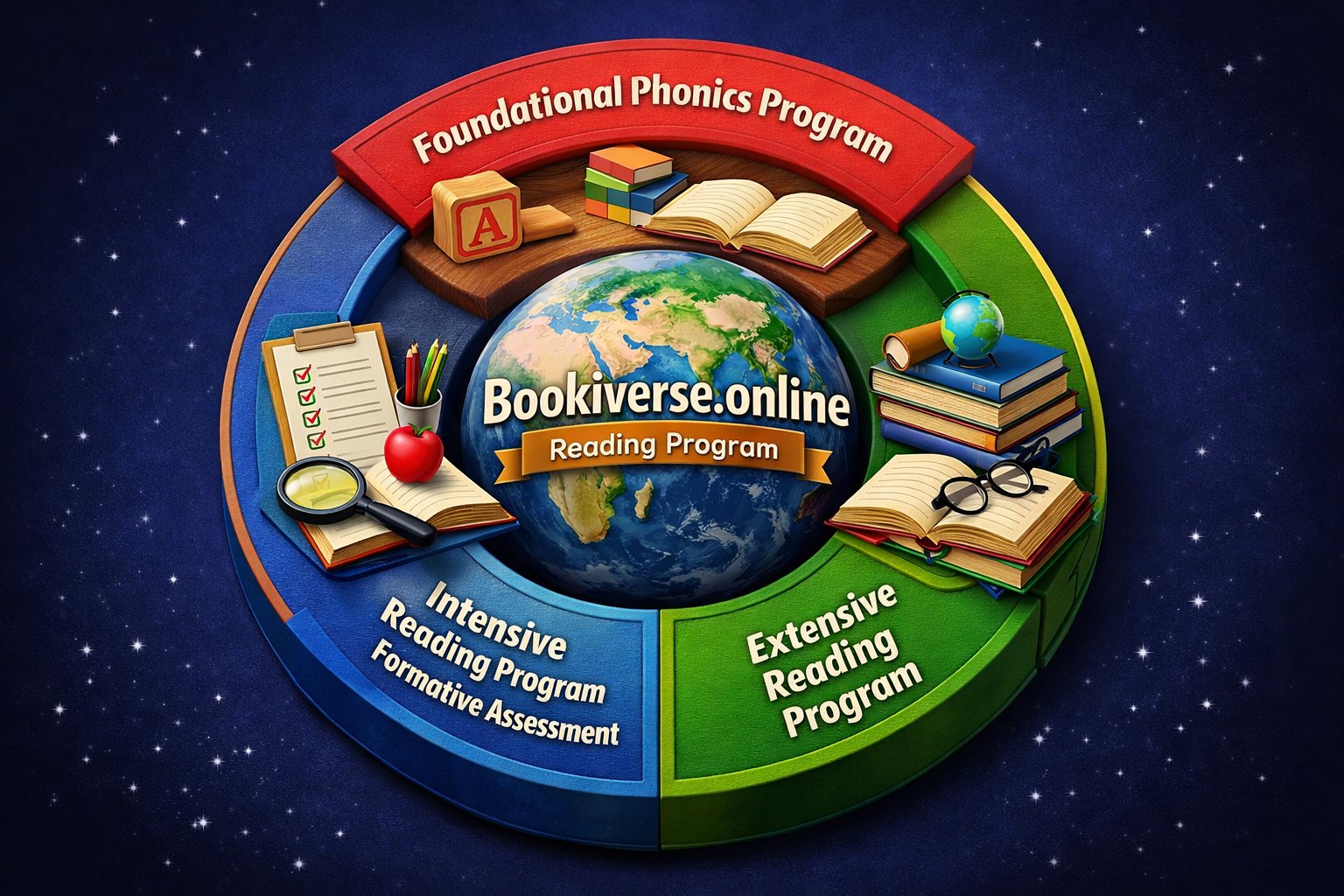
Learners need different kinds of reading at different stages. Phonics gives beginners the letters and sounds of English, and can be used by both first-language (L1) and second-language (L2) learners; extensive reading builds fluency and vocabulary through volume and enjoyment; intensive reading checks understanding with comprehension questions and an instant score. The extensive and intensive reading programs are designed mainly for learners of English as a second or foreign language. All three are levelled by the CEFR, from A1 to C2.

  • Not sure where to start? The English Proficiency Test (ages 6–15) recommends the level of books to read.
  • Listen while you read: audio narration and Read Aloud connect each word with its pronunciation.
  • Practise the words of each level with the vocabulary challenges and the Vocabulary Trainer.
  • Keep a record: with an account, your books and scores are saved to your dashboard.
An infographic detailing the three Bookiverse reading programs: Foundational Phonics, Extensive Reading, and Intensive Reading.
International reading assessments

Preparing for PIRLS and PISA

PIRLS and PISA are the two main international assessments of reading. Each is described below: what it measures, who takes it, when and how, and why students and countries take part. Bookiverse has a practice hub in English for each of them. The hubs can be used by all schools and teachers that teach English as a first language or use it as a medium of instruction, and that take part in these assessments in English.

IEA · Grade 4

PIRLS

Progress in International Reading Literacy Study

What it measures

Reading comprehension for two purposes: reading for literary experience, and reading to acquire and use information. The questions cover four processes: focusing on and retrieving explicitly stated information, making straightforward inferences, interpreting and integrating ideas and information, and evaluating and critiquing content. Questionnaires for students, parents, teachers and schools collect information on the conditions in which children learn to read.

Who takes it

Students in their fourth year of formal schooling (Grade 4), in a representative sample of schools in each participating country. PIRLS 2026 involves 64 education systems.

When

Every five years since 2001. In PIRLS 2026, data collection runs from March to June 2026 in the Northern Hemisphere and from September to December 2026 in the Southern Hemisphere. The results are planned for December 2027.

How

From 2026, PIRLS is fully digital. Students read literary and informational texts on screen, including ePIRLS tasks on simulated websites, and answer multiple-choice and written-response questions. The assessment is run by IEA through the TIMSS & PIRLS International Study Center at Boston College.

Why students and countries take part

Countries take part to obtain internationally comparable data on how well their children read in the fourth year of school, to follow trends from one cycle to the next, and to judge whether new or revised policies affect achievement. The results also feed national reporting on SDG 4. Students are selected through the sample and take part on behalf of their education system; they do not receive individual scores.

Minimum proficiency level

Results are reported against four International Benchmarks. The Low Benchmark (400 points) is the minimum proficiency level used to report on SDG indicator 4.1.1 at the end of primary education. Students below it cannot yet reliably locate and retrieve information stated explicitly in a text.

International Benchmarks
  1. Minimum400Low
  2. 475Intermediate
  3. 550High
  4. 625Advanced
Open the ePIRLS hub
OECD · Age 15

PISA

Programme for International Student Assessment

What it measures

Reading, mathematical and scientific literacy, with an innovative domain in each cycle. Rather than testing a school curriculum, PISA measures how far 15-year-olds can use what they know to meet real-life challenges. In reading, this means understanding, using, evaluating, reflecting on and engaging with texts. Questionnaires collect information on students' backgrounds, attitudes and schools.

Who takes it

Students aged 15 (between 15 years 3 months and 16 years 2 months) in Grade 7 or above, in a representative sample of schools. PISA 2025 involved about 760,000 students in 91 countries and economies.

When

Every three years from 2000 to 2025, and every four years from 2029. The PISA 2025 results were published on 8 September 2026. Reading will be the main domain of PISA 2029.

How

A computer-based test of about two hours in reading, mathematics and science, with an innovative domain in each cycle. The reading test is adaptive: early answers route students to easier or harder sets of questions. Tasks include single texts, multiple texts and simulated websites.

Why students and countries take part

Countries take part to see how well their education systems prepare students near the end of compulsory schooling for further learning and for social and economic life, to compare their results with those of other systems, and to follow trends over time. The results inform education policy and national reporting on SDG 4. As in PIRLS, students are selected through the sample and take part on behalf of their education system; they do not receive individual scores.

Minimum proficiency level

Results are reported in eight proficiency levels, from Level 1c to Level 6. Level 2 (from 407 points) is the minimum proficiency level: the baseline the OECD considers necessary to participate fully in society. It is also used to report on SDG indicator 4.1.1 at the end of lower secondary education.

Proficiency levels
  1. 1c
  2. 2621b
  3. 3351a
  4. Minimum4072
  5. 4803
  6. 5534
  7. 6265
  8. 6986
Open the PISA hub

Why preparation matters

Familiar question types, layout and levels

Students show their reading more fully when the format of the test is not new to them. Practising with the question types (multiple choice, short written answers, tasks across several texts), the on-screen layout (scrolling passages, tabs and simulated websites) and the proficiency levels lets students focus on the reading itself.

A minimum level for every student

Each assessment sets a minimum proficiency level: the Low Benchmark in PIRLS and Level 2 in PISA. It is vital that all students attain it, because students below it do not yet have the reading skills they need to learn in other subjects and to take part fully in society.

Higher levels for the country

Attaining the higher levels is also vital for a country and its society. Research using international assessment data links the skills of a population with its long-run economic growth. Larger shares of students at the higher levels strengthen human capital, help sustain economic growth and improve a country's competitiveness.